For updated information
regarding NADA/F's 7th Annual Meeting, please see the front
page of our web site.
NADA/F at Jet Blue “Care Team” Training…
“August 2nd I attended a JetBlue Care Team Training Session, and talked about my experience of losing our loved ones (family of five) on NW255, August 16, 1987, and about the work that NADA/F is doing for support of victims’ families. It was great to share the day with the JetBlue Care Team employees, and learn more about how well organized and dedicated they are. I can’t thank them enough for the warm welcome that I received and for the great job that they are doing.”
- Joan Pontante
NADA/F members have volunteered and helped with Care Team Training for a number of the airlines. Our survivors and family members share a wide range of experiences from over 80 air disasters, some recent, to air crashes 50+ years ago. We always look forward to working with the airlines. The airlines cover transportation expenses, and NADA/F welcomes the opportunity to participate.
BOOKS…
NADA/F is accepting new and used book donations for the Book Sale at the Annual Meeting. We are particularly interested in books on helping with bereavement, as well as informational books about the airline industry.
Mary Kahl, BOOKS, MKahlcul8@aol.com
(724) 864-0026 - 1917 Victoria Lane, Irwin PA 15642
NADA/F represents survivors and those who have lost loved ones in over 80 aviation disasters. Four of those crashes were on Halloween. On October 31, 2001, please remember our friends from the following:
Singapore 006, October 31, 2000
Taipei, Taiwan, 747-400, 83 fatalities, 96 survivors.
Egyptair 990, October 31, 1999
Nantucket Island, MA, 767-300ER, 217 fatalities.
American Eagle 4184, October 31, 1994
Roselawn, IN, ATR-72, 68 fatalities.
Western Airlines 2605, October 31, 1979
Mexico City, DC 10, 98 fatalities, including 40 people on the ground, and those who died later from crash injuries, and 12 survivors.
August 12, 2001 – 16th Memorial for JAL 123
We noticed the following on a stone memorial marker as we walked up Mt. Osutaka:
“As I climbed up that mountain, I had a spiritual experience. As we walked up the mountain, we were alongside the water all the time, and I had the sense that the water was almost talking to us, encouraging our climb. It is my hope that the memories of those who died on that mountainside and every other crash site across seven continents will forever water our efforts to prevent these things from happening.”
- Jim Burnett, 1991, former NTSB Chair
(Burnett returned in 1994 to dedicate the marker that had been engraved with his words).
Mary Schiavo and I recently visited Japan for the 16th memorial of Japan Airlines 123, the largest single air disaster in history. We shared the experience with Dr. Kawakita who provided the leadership to establish the JAL123 memorials, and the air safety organization, IREI, “International Rally of Endeavors to Improve.” IREI believes the sky is one.
Mount Osutaka is now a memorial to the 520 souls and 4 survivors on board. We began with a 1-2 hour very physical climb to the sites of the crash. You quickly learn that this beautiful peaceful mountain, is unlike any other mountain in the world, and is deeply scarred by the disaster.
When the recovery of the victims began, the mountain was marked with a grid of numbers and letters, and each victim was assigned a number/letter that matched the grid location. You begin to see the markers near the summit. Before you reach the first summit JAL is at a side area to bow and serve cold tea to the
climbers.
We spent about two hours following the trails on the mountain, visiting the personal markers and shrines that have been established through the years. Along the path there was occasional music from singing, accordions, flute and violin.
One of the last areas that we visited was a valley where the tail of the plane slid to rest, and 4 lone survivors were rescued there almost 15 hours after the crash. The U.S. military offered to help right after the crash, but the help was turned away. It appears that many others would have survived if there had been rescue efforts the evening before. In this “survivor’s valley” we rested and shared the music, love and friendship with the family members. They spoke Japanese and we spoke English, however, we shared a universal language of loss and remembrance.
Evening Memorial
From 6-7pm there was a memorial service at the IREI-NO-SONO Shrine where the cremated ashes of unidentified victims are enshrined. The ceremony had soft Japanese music, white chrysanthemums, 520 white candles, and the dignitaries wore black mourning suits. It was most impressive when the Japan Airline executives, including the President of JAL, all in black mourning suits, went to the family members and bowed to the waist to show respect and apology to the families. It was a peaceful farewell to a very emotional day.
- Gail Dunham
“Love the children and teach them to travel.”
In Japan there is a saying “Love the children and teach them to travel.” And so we do. We entrust our most precious loved ones to the airlines, to the aircraft manufacturers, and most of all to the government. We assume everyone is doing his or her job in the proper way with all due care, and with honesty and honor. We assume because we must. The information that would inform us of the quality and honesty of transportation’s work is kept from us by the airlines, the manufactures, and worst of all, by the government.
But fortunately in this world there are people who remember, and who help others to remember, and who work to make amends by correcting this situation. Fixing the problems that have already killed and injured is a very, very small favor to ask for what has been done.
My experiences on the mountain and at the memorial service was a life-defining moment, for it is there, on the side of Mt. Osutaka, that 520 lives are made real again. The full impact of actions, and lack of responsibility, is apparent in seeing 520 markers on the side of the mountain, many of them bearing the names and remembrances of children we entrusted to the care of the government and the aviation industry.
Dr Kawakita said he continues to look upward, because otherwise the tears cloud his vision and fill his eyes. Looking upward, they roll out of his eyes and down his face, but he can see to go onward. And so shall I and others fighting for transportation safety, for there is a reason we were chosen by our circumstances--possibly it is because we can make a difference. That Is what I believe. That is what keeps me going forward, and I am grateful, honored and inspired to meet my counterparts in Japan. I shall never, never forget why we do what we do, after climbing the mountain. We do what we do because we must. My deepest honor and respect to my Japanese counterparts. I thank you.
- Mary Schiavo, August 12, 2001
Visit the JAL 123 website:
www.PlaneSafe.org/jal123/ Revisit Dr. Kawakita’s presentation to NADA/F at our Annual Meeting, 2000, and learn about the history of JAL123 and IREI, the Japanese Aviation Safety Organization.
NADA/F - MAKING A DIFFERENCE for AVIATION SAFETY…
NADA/F Members Serving on FAA Aviation Rule Making Advisory Committees (ARAC)…
What is ARAC?
The Secretary of Transportation chartered FAA Aviation Rulemaking Advisory Committees (ARACs) in 1991. The purpose of ARACs are to assist the FAA by providing forums for interested parties to participate in open negotiations on major regulatory issues, and provide input to the FAA’s regulatory agenda. In May, 1991, ARACs had 56 member organizations, 9 Issue Groups, and 14 Working Groups. In 2001 ARACs have 75 member organizations, 11 Issue Groups and 75 Working Groups. ARAC is part of the decision-making authority of the FAA. NADA/F appreciates that the FAA Administrator Jane Garvey has demonstrated a commitment to improving public participation in the FAA ARAC process.
NADA/F’s Role…
NADA/F was approved by the FAA, in mid-2000, as one of the 75 member organizations for ARAC participation. NADA/F needs dedicated and qualified volunteers to represent us on ARAC committees. The Issue Groups propose safety recommendations to the FAA, which is the ultimate decision-maker. ARAC’s goal is to involve interested members of the aviation community, and the general public, in responsible dialogue with the FAA.
NADA/F Progress…
In 1999 NADA/F successfully appointed one person to a Working Group. We are now an official member organization with over 12 appointees, plus a seat on the ARAC Executive Committee (ExCom). We may appoint representatives to any of the 11 Issue Groups, and the Working Groups. The Issue Groups generally meet quarterly, usually in Washington DC, and receive reports and recommendations from their Working Groups. Working Groups are oriented toward specific task(s) and meet for a limited time, usually a year or two. Extensive time and travel may be involved during participation in Working Groups. Meetings of the ExCom and Issue Groups are open to the public; those of the Working Groups are not.
NADA/F is also permitted representation on an FAA ARAC Security group, and the Aging Transport Systems Rulemaking Advisory Committee (ATSRAC). These are separate from, but operate similar to ARACs. We have representatives on both Security and ATSRAC.
How to Learn More…
More information is available on the FAA Home website: <http://www.faa.gov> and the FAA’s Office of Rulemaking website: <http://www.faa.gov/avr/armhome.htm> ARAC Meeting Schedules are available at: <http://www.faa.gov/avr/arm/araccal.htm>. Newly organized Working Groups are posted on the FAA website and the Federal Register, which is updated daily. People who are not able to travel can participate with a group via the Internet, however, this takes discipline to stay current with the group.
Qualifications for Appointment…
NADA/F needs to appoint people who are devoted to improving aviation safety for the public, and who will commit to staying current with the safety issues of their ARAC assignment, and will take the initiative to attend meetings and stay involved with the group. We also need family members to ask the common sense questions. Persons who represent NADA/F must put aside any personal agenda and represent the organization’s objective of benefiting as many people as possible.
If you are interested in serving on an ARAC Issue or Working Group, the first step is for you to submit a Letter of Intent to NADA/F stating your desire to serve, and a Resume, which contains any qualifications or experience in aviation and/or public interest activities, or personal experiences that have motivated you to become involved. NADA/F, as an ARAC member organization, recommends representatives to the FAA, which has final approval authority. Once appointed, the individual will function as a NADA/F representative to the specific Issue Group or Working Group.
NADA/F representatives must have the ability to participate in e-mail communications, access to the Internet for meeting schedules and agendas, and FAX communications. NADA/F procedures are to ensure that our representation is positive, credible and as standardized as possible.
CONTACT INFORMATION:
Please keep in mind that we have no staff and/or secretary for ARAC volunteers.
Ira Rimson has generously offered to coordinate our ARAC participation; and we greatly appreciate his help.
Ira Rimson – NADA/F Coordinator for FAA ARAC Participation
2120 Kirby Street NE E-mail: irimson@earthlink.net
Albuquerque NM 87112-3476 Phone and Fax: 505-275-4970
NADA/F Proudly Announces our FAA ARAC Appointees as of September, 2001…
Special Thanks to our Volunteers! They are doing a terrific job!
Executive Committee: Bill Kauffman, Ph.D., Aerospace Professor at University of Michigan.
(734-936-0104 – Email: cwkauff@umich.edu)
Executive Committee Alternates: Paul
Smith, retired Air Force Lt.Col., ValuJet 592, and Tom O’Mara, United 232. (Paul Smith 817-370-4644 Email: laurie0222@aol.com)
(Tom O’Mara 651-408-8310 - Email: t.j.omara@worldnet.att.net)
Fuel Tank Inerting Harmonization Working Group: Jim Hurd, TWA 800,
Bill Kauffman, and Steve Finley, from BOC Gases, representing NADA/F. (Jim Hurd 410-802-6059 Email:
CYN29HU@yahoo.com)
Occupant Safety Issue Group, formerly Emergency Evacuation: Matthew Ziemkiewicz, TWA 800.
(201-933-2082 – Email MRZ329@aol.com)
Airport Certification Issue Group: Matt Ziemkiewicz.
Air Carrier Operations Issue Group: Barbara McFann, lost her husband (retired Delta pilot) in Sky Warriors, a recreational flight. (770-442-0391)
Transport Airplanes and Engines Issue Group: Jack
Murphy, lost his son on a Delta Commuter/Business Express pilot Training Flight. (203-795-9027 – Email:
JEDW@optonline.net)
Aircraft Certification Procedures Issue Group: Janice Maniatis.
Air Carrier/General Aviation Maintenance Issue Group: Janice Maniatis.
(Committees were scheduled back to back – 770-486-5630 Email: jmaniati@att.net)
Rotorcraft: Robert Rendzio (Appointment pending).
ATSRAC - Aging Transport Systems Rulemaking Advisory Committee, also called “Aging Aircraft”: Gary Slater, Ph.D., Department Head and Aerospace Professor at University of Cincinnati, and
Christine Negroni, Alternate, and author of “Deadly Departure” (Email:
christine.negroni@home.com)
Aviation Security Advisory Committee: Bob
Monetti, NADA/F Board Member and President of PanAm 103. Monetti worked to found the committee and observed since 1989. Monetti has been an official member of the committee since 1991. (609-405-6169 – Email:
bobmonet@mindspring.com), and,
Glenn Johnson - PA103, and NADA/F Founding Member, also helped found the Security Committee and has served since 1989. (Email: Johnson
VPAF103@cs.com)
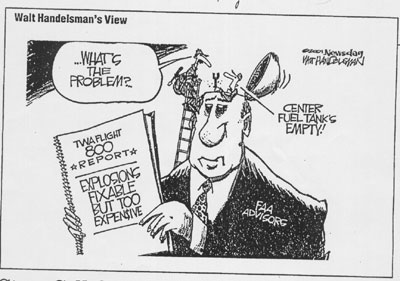
Join us at the Annual Meeting to learn more about how NADA/F’s participation in the Fuel Tank Inerting Group is making a difference. This technology would have prevented the crash of TWA 800, and probably as many as 14 or more other center wing tank explosions. Your help can make a difference!
ANOTHER GOAL ACCOMPLISHED…
June 5, 2001, the NTSB released a Revised Final Report for United 585, the Boeing 737, which crashed over ten years ago on March 3, 1991, at Colorado Springs, CO.
The NTSB has formally revised the Probable Cause for United flight 585 to be:
“A loss of control of the airplane resulting from the movement of the rudder surface to its blowdown limit. The rudder surface most likely deflected in a direction opposite to that commanded by the pilots as a result of a jam of the main rudder power control unit servo valve secondary slide to the servo valve housing offset from its neutral position and overtravel of the primary slide.”
United 585 was possibly the first major commercial airline crash with no Public Hearing back in 1992. A meeting was held which tended to blame the wind for the crash, while the true probable cause was always the rudder reversal. The first final report was issued December 8, 1992. UA585 is now one of the few major commercial airline crashes with a Revised Final Report.
We very much thank the NTSB for their diligence, years of investigation, and for the extensive revisions to the report.
On March 24, 1999, at the USAir 427 Final Public Hearing the NTSB issued a Probable Cause for US427 and UA585 as rudder reversals, however, it has taken two years to have these statements incorporated into the Revised Final Report for UA585. For years the industry blamed UA585 on the wind, although Chairman Hall stated (March 23-24, 1999) that the NTSB knew UA585 was not brought down by the wind because there was no change in the altitude or speed recorded on the flight data recorder. Jim Hall stated that it would have taken a wind rotor at least 36 times greater force than the strongest wind rotor ever
documented in Colorado Springs to possibly disrupt the 737.
Some information added to the Revised Final Report was known in 1991-1992, and some reflects more recent research. The Revised Final Report includes important key points about the Boeing 737, and the probable cause of UA585, such as the following.
· The 737 is the only commercial jet aircraft in the U.S. with one power control unit (PCU) system and a single rudder panel. Other commercial aircraft have two or more power control systems. (Page 13).
· There are many statements such as the following, which makes it clear that wind did not bring down the 737. “Thus, the simulations showed that wind excursions alone did not result in the United flight 585 upset and loss of control.” (Page 60).
· The report includes information, which was excluded from the first final report about the “Mack Moore” United 737 incident of July, 1992. It was a significant event because the tests proved that there was a potential for a rudder reversal on all 737’s, and many people were involved in those tests. (Page 69-70)
· We now know that on March 18, 1999, Parker Hannifin (manufacturer of the 737 servo valve) advised the NTSB of engineering documents from 1966 which revealed important servo valve modifications to the prototypes, which would “not cause reverse flow.’” (Page 21) (This indicates that the manufacturers knew about the potential for rudder reversal since 1966).
· The Revised Final Report lists five “Other Documented Rudder Control Incidents” (Page 68). The footnote refers to 8 (eight) additional rudder incidents reported in the US427 report. Also, January 1999, Parker Hannifin notified the NTSB that a recent search produced three additional reports from 1982 through 1984! Neither report has a complete list of 737 rudder anomalies.
· There are also references to other fatal aviation accidents that involved flight control reversals. (Page 79).
· The Revised Final Report Findings continue to call for the FAA to mandate upgraded Flight Data Recorders. (FDR) (Page 114) The Black Box is the most important tool in air crash investigation, yet state-of-the-art FDR are more often found on European airplanes. Boeing needs to install the best Cockpit Voice Recorders (CVR) and FDR as standard equipment in new planes, and the FAA needs to mandate this known technology).
· The UA585 aircraft had rudder control problems six days before the accident flight and four days before the fatal crash. (Page 120)
A copy of the 214-page report may be viewed at the NTSB website:
www.ntsb.gov Printed reports are available through the National Technical Information Service at (800) 533-NTIS.
The NATIONAL AIR DISASTER ALLIANCE / FOUNDATION will continue to support all those impacted by these devastating air disasters, in their search for the truth, via support for prompt disclosure of air crash investigation information, support for True Public Hearings, release of air crash information during the investigation, and compliance with the Freedom of Information laws. The NTSB conducts air crash investigations, however, the airline industry is often 90% of the team, and so too often the industry investigates themselves. NADA/F supports the need for Independent Oversight of air crash investigations so the traveling public is represented in this process.
For me personally this has been an emotional ordeal for over ten years. In 1991 we were denied a Public Hearing, and considerable information was withheld from the family members and the public in general. I was privately told that the cause of UA585 was the rudder failure, yet the industry went to extensive means to blame the wind and anything but the True Probable Cause. Some of the disclosure represents data through improved technology, however there is also information that should have been public long ago. It appears that improvements have been made to the 737-rudder design, however, it is long overdue to re-design the next generation of Boeing aircraft with two or more power control units, to truly have a back up, similar to other commercial aircraft. Our loved ones are worth it, and so are yours!
- Gail Dunham
The Revised Final Report for UA585 leaves three air crashes as unsolved, in the 34-year history of the NTSB.
· Jan. 6, 1969, Convair 440 in Bradford PA that killed 11
· Nov. 14, 1970, a DC-9 in Huntington WV that took 75 souls, including the Marshall University football team
· March 13, 1974, crash of a Convair 340/440 in Bishop CA that took 36 lives, including a film crew.
For updated information
regarding NADA/F's 7th Annual Meeting, please see the front
page of our web site.
IF THIS IS YOUR FIRST MAILING FROM US AND YOU WOULD LIKE TO BE ON OUR MAILING LIST PLEASE LET US HEAR FROM YOU! EMAIL TO:
GADunham@aol.com, OR, Call toll free 888-444-6232 ....for air safety and security